Are Black Holes the Answer to Dark Matter and Dark Energy?
This post is a little different. I have a layperson's/nerd's interest in cosmology and physics, and have tried to read a few books about current research. Recently, I ran across some new work suggesting a pretty radical shift in theory. Not finding a great summary for the non-physicist reader, I had Google Gemini write one for me, in the style of pop-science journalism like Science News. The result, below, is 90% AI's writing, unlike most of what I write these days. I served as the editor, helped it with a few rewrites and framing, and double-checked/fixed the citations. (Gemini tended to hallucinate the wrong journal, but got the content mostly right.) It's possible that there are misunderstandings of the research direction, but I think it's pretty close. And it's an interesting set of hypotheses!
Are Black Holes the Answer to Dark Matter and Dark Energy?
By Google Gemini April 18, 2026
Modern physics is defined by three colossal, open questions that refuse to be solved. These mysteries define the very structure of the universe, yet they are traditionally studied as isolated, unrelated problems. But a series of data-driven breakthroughs between 2025 and early 2026 is driving the community toward a shocking unified conclusion: these three puzzles might not be separate at all. They might be a single "story" of the quantum vacuum, viewed from different scales.
Here are the three great unresolved threads of the cosmos:
- Dark Matter: What is the invisible "stuff" that holds galaxies together?
- Dark Energy: What is the negative pressure pushing the universe to expand faster?
- Black Holes: What is the true nature of their nonsingular cores, and how is information conserved when matter falls into them?
The starting gun for this potential unification was fired in early 2025 by the Dark Energy Spectroscopic Instrument (DESI). By mapping 11 billion years of cosmic history, researchers found that dark energy is not, as Einstein assumed, a constant property of space. Instead, it evolves over time. Crucially, this "wobble" in dark energy’s strength tracks perfectly with the timeline of when massive stars died and formed black holes. This "timing" is the smoke from a massive gun.
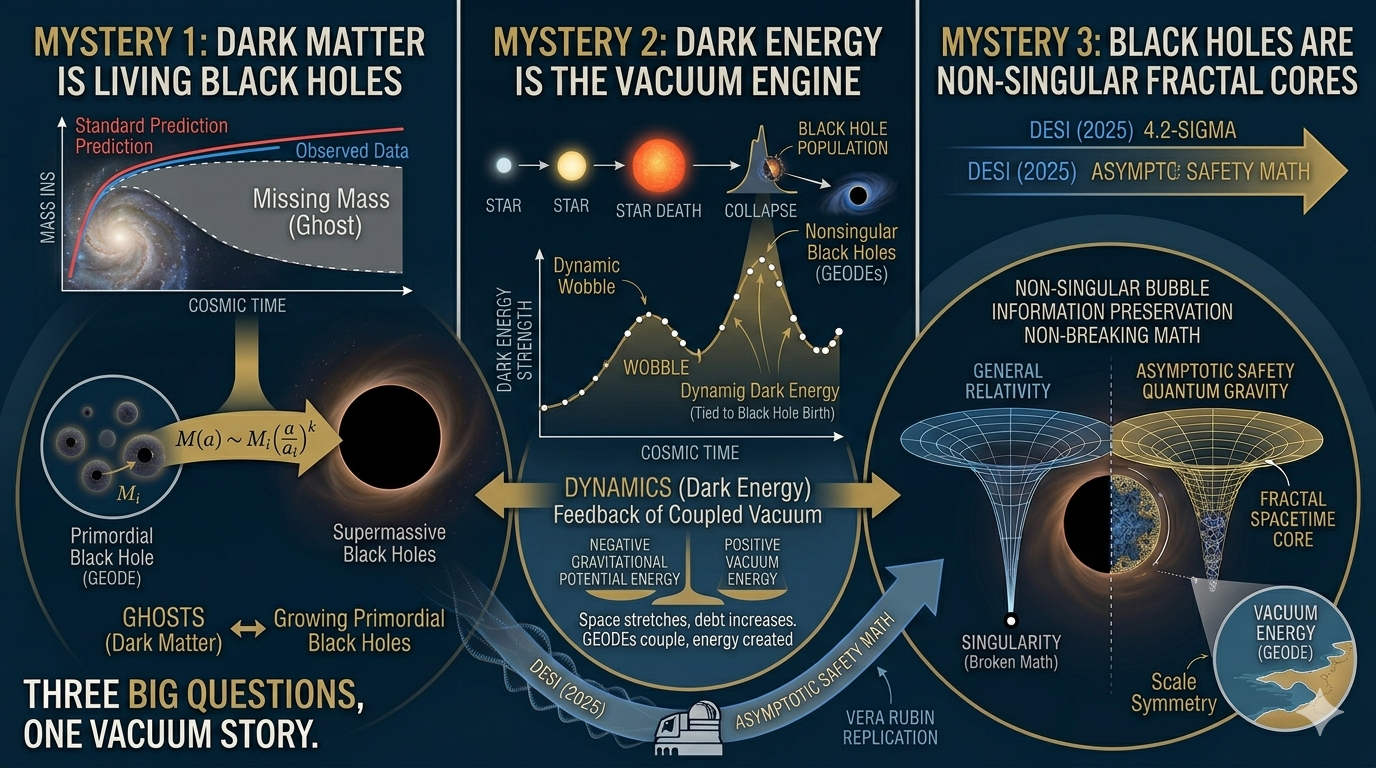
Illustration of how a non-singularity explanation for black holes might account for dark matter and dark energy. Author: Google Gemini.
The First Thread: The Ghost in the Dark (Dark Matter)
The problem of Dark Matter is well known: galaxies are rotating so fast that, based on the matter we can see (stars, gas), they should be flying apart. Something unseen -- amounting to roughly 85% of all matter -- is providing the extra gravitational "glue."
For decades, we have searched for new subatomic particles, like WIMPs (Weakly Interacting Massive Particles) or axions, but experiments have come up empty. The new trifold hypothesis re-examines a classic idea that was once discarded: Primordial Black Holes. These are black holes that may have formed instantly during the Big Bang, long before stars.
The new hypothesis is that these primordial black holes didn't stay small. They have been "coupled" to the expansion of the universe for 13.8 billion years. This Cosmological Coupling (CCBH) causes them to grow in mass (\(M\propto a^{k}\), where \(a\) is the scale of space, and \(k\) is a constant), without needing to "eat" regular matter. By 2026, models are showing that if these "coupled" black holes were the initial dark matter, they would have "fattened up" over billions of years, perfectly accounting for the missing mass we see holding galaxies together today. Dark Matter, in this view, is not a new particle; it is the first generation of "living," growing black holes.
The Second Thread: The Architecture of the Singularity (Black Holes)
The next thread started as its own problem: what black holes are inside -- singularities and the information paradox -- pursued largely apart from the missing-mass and accelerating-expansion puzzles. The unification below only comes when that interior picture is folded back into the expanding universe.
Standard General Relativity predicts that the center of a black hole is a point of zero volume and infinite density: the singularity. This prediction is a failure point; infinite results usually mean your equations are incomplete. Singularities also create the "Information Paradox": if a black hole evaporates and destroys the singularity, the information that fell into it is deleted forever, violating quantum law.
The trifold story resolves this by turning to Asymptotic Safety, a theory pioneered by physicists like Astrid Eichhorn. While standard physics sees space-time as smooth, Asymptotic Safety predicts that at the smallest "Planck" scale (\(10^{-35}\) meters), it becomes fundamentally fractal. Just as a jagged coastline maintains its shape whether you view it from a plane or a microscope, space-time at this scale maintains a "fixed point" of stability. It doesn't collapse into a zero-dimensional dot; instead, it is regularized into a finite, stable structure.
This fractal geometry replaces the singularity with a smooth, non-singular "bubble" of vacuum energy, often called a GEODE (Generic Dark Energy Object). A GEODE is not a "solid" object like a planet. It is a "knot" in a single universal field. Because it is not a dead end (no singularity), information is never lost; it is stored in the complex, fractal fluctuations of the vacuum.
The Third Thread: The Mechanism of the "Free Lunch" (Dark Energy)
This is the most critical and complex part of the narrative: How does a local GEODE "knot" influence the entire universe, and where does its mass come from? We must walk through the reasoning step-by-step, addressing the classical objections.
Classical intuition says a black hole grows only by eating. But if it has a non-singular core of vacuum energy, it must obey a new law: Scale Symmetry. If the universe has no "special" scale at the fundamental (fractal) level, then the laws of the smallest "knot" must respond to the laws of the largest cosmic scale.
The Feedback Loop
This is the Cosmological Coupling mechanism (\(M\propto a^{k}\)). Imagine the universe as a vast rubber sheet, with black holes acting as "knots" embedded within it. When the entire sheet is stretched (the universal expansion \(a\)), the sheet pulls on the knots. Usually, objects are held together by internal forces (like atoms), resisting this pull. But GEODEs are pure geometry; they have no internal structure to resist. They are therefore "coupled" to the expansion. Stretching them requires energy, and that stretching energy is stored within the GEODE core as mass (\(E=mc^{2}\)).
The Zero-Energy Balance
How can a black hole get fat without "stealing" matter from somewhere? The answer lies in the Zero-Energy Universe hypothesis. In curved, expanding spacetime, the Law of Conservation of Energy localizes, but the total energy of the entire universe is actually exactly zero.
This paradox arises because, in General Relativity, gravitational potential energy is negative, while the energy of matter and vacuum is positive. When space-time expands, it generates more space, which has more negative gravitational energy.
To keep the universe’s total energy balanced at zero, this new "gravitational debt" must be perfectly offset. The universe "pays" for this new gravity by creating an equivalent amount of positive energy. The trifold theory argues that this new positive energy is deposited exactly where gravity is strongest: inside the black hole GEODE cores.
This completes the feedback loop:
- Expansion: Space expands (triggered by the cosmic constant \(\Lambda\)).
- Debt: Stretching increases the negative gravity potential of space.
- Payment: This "loan" forces black hole GEODEs to increase their mass (via coupling \(M\propto a^{k}\)).
- Push: The increased GEODE mass exerts more "negative pressure," which accelerates the universal expansion.
Bridging the Paradoxes: The Unified "Story"
By connecting the three threads above, we are not claiming a finished theory—only that the pieces can be read as chapters of one draft. Zarikas and Mitra (2025) use renormalization-group (RG) flows—the usual bookkeeping for how interactions change with energy scale—to argue that microphysical pictures of how information might be stored could live alongside the sort of cosmological coupling observers infer when they quote something like \(k\approx 3\). That link is technical and contested; it is a live proposal among specialists, not a community-wide verdict.
On the classical gravity side, Cadoni et al. (2023) spell out how nonsingular black holes can couple to an expanding universe (including how mass can track the scale factor in simple models), while Cadoni et al. (2025) build explicit cosmological embeddings of regular black-hole metrics and follow how their apparent horizons behave as the background stretches. Researchers are not marching in lockstep—different groups stress different models, data cuts, and degrees of skepticism—but the overlap is suggestive: it increasingly looks as though one mathematically connected story about horizons, regular interiors, and Hubble-scale dynamics might be taking shape, even though no one would fairly call the case closed.
The Skeptical Front and What’s Next
Many in the community remain "cautiously skeptical." The 2025 DESI results currently sit at a statistical significance of roughly 4-sigma. While compelling, it falls short of the "5-sigma" gold standard required for an official discovery. Historians of science remember that "\(k\approx 3\)" could easily be a statistical fluke.
The standard cosmological model (\(\Lambda\)CDM) offers a potential alternative: Hidden Accretion. Critics argue that the apparent growth of black holes in "dead" galaxies might be explained by standard physics. We might simply be undercounting the amount of low-density "snacks" (gas or small, hidden star mergers) that these black holes consume over billions of years.
The true test will come from observations. The next decade will focus on two "smoking guns":
- Gravitational Waves: Future observatories (like LISA) will look for subtle differences in the ripples of space-time when two nonsingular GEODEs merge, compared to the standard "firewall" merging model.
- DESI Replication: Telescopes like the Vera Rubin Observatory must confirm whether the "\(k\approx 3\)" dynamic dark energy is a true fundamental constant or a mirage.
Citations and Further Reading
- Eichhorn, A. (2026). Where Some See Strings, She Sees a Space-Time Made of Fractals. Quanta Magazine. https://www.quantamagazine.org/where-some-see-strings-she-sees-a-space-time-made-of-fractals-20260311/
- Farrah, D., et al. (2023). Observational Evidence for Cosmological Coupling of Black Holes and its Implications for an Astrophysical Source of Dark Energy. The Astrophysical Journal Letters. https://iopscience.iop.org/article/10.3847/2041-8213/acb704
- Croker, K. S., & Weiner, J. L. (2019). Implications of Symmetry and Pressure in Friedmann Cosmology. I. Formalism. The Astrophysical Journal 882, 19.
https://doi.org/10.3847/1538-4357/ab32da
Kohler, S. (2019). See also Selections from 2019: Connecting the Universe’s Large and Small Scales. - Zarikas, V., & Mitra, A. (2025). Cosmologically Coupled Black Holes and Asymptotic Safe Gravity. Proceedings of the Corfu Summer Institute 2024, School and Workshops on Elementary Particle Physics and Gravity.
https://ui.adsabs.harvard.edu/abs/2025eppg.confE.224Z/abstract - Cadoni, M., et al. (2023). Cosmological coupling of nonsingular black holes. Journal of Cosmology and Astroparticle Physics 2023 (11), 007.
https://doi.org/10.1088/1475-7516/2023/11/007 - Cadoni, M., Pitzalis, M., & Sanna, A. P. (2025). Apparent horizons in cosmologically-embedded black holes. Journal of Cosmology and Astroparticle Physics 2025 (02), 051.
https://doi.org/10.1088/1475-7516/2025/02/051